

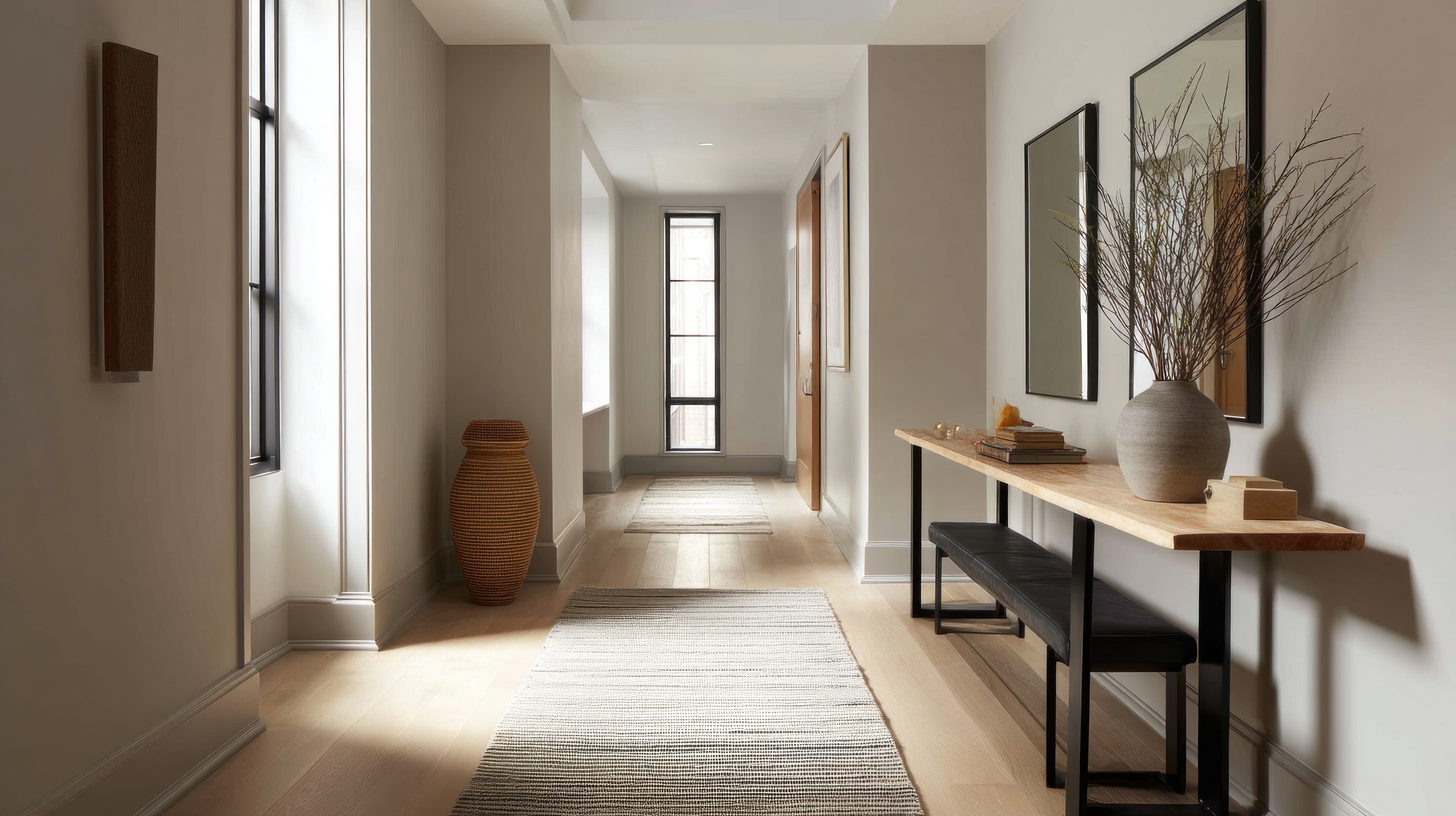
An entryway rug has a practical job beyond catching dirt. It should soften the first few steps into your home without becoming a speed bump for the front door. When a rug is too thick, the door may drag, bunch the rug, or stop opening fully. The right area rugs balance cushioning, appearance, and clearance.
Start With the Door Clearance
Before shopping, measure the space between the bottom of the door and the finished floor. Open the door slowly and watch where its lowest edge passes. The available gap, rather than the rug's advertised thickness alone, determines what will work. Remember that a rug can compress underfoot. A dense, low-profile rug may measure slightly thicker than its compressed height, while a plush rug can create more resistance as the fibers flatten.
If the door swings over the rug, leave enough clearance for everyday movement, not just a barely acceptable fit. Also check the door sweep, threshold, and any trim near the opening. A door with a tight seal or low threshold can have less usable clearance than it appears to have from across the room.
Choose a Low Profile for Busy Entryways
For most exterior doors, a low-profile rug is the safest starting point. Flatwoven rugs, tightly constructed rugs, and mats designed for entry areas tend to sit closer to the floor than thick shag or high-pile styles.
A thin rug can also be easier to vacuum and less likely to catch shoes. That matters in an entryway where wet boots, grit, leaves, and everyday traffic are common. If you want more cushioning, look for a rug that compresses modestly without creating a tall, soft edge.
Consider these practical priorities:
Measure door clearance before choosing a rug.
Account for the rug pad, not just the rug itself.
Prefer low-profile construction where doors swing across the rug.
Keep the rug flat and secure so its edges do not curl.
Recheck clearance after the rug and pad are installed.
The rug pad deserves special attention. A pad can improve grip and make a thin rug feel more substantial, but it also adds height. If the entry has a very small clearance, think of the rug and pad as one system rather than two separate purchases. For a door that barely clears the floor, a slim, nonslip pad is usually more appropriate than a cushioned pad designed for a living room.
Match Thickness to the Door and Traffic
Not every entryway needs the same rug thickness. A door that swings away from the rug gives you more flexibility. A door that swings directly over it requires a much tighter fit. Traffic also changes the equation. In a busy household, a very delicate low-profile rug may not provide the durability or dirt-trapping performance you want.
A practical entry rug should lie securely, resist shifting, and tolerate repeated cleaning. If you are placing a rug inside a door with a threshold, measure from the threshold's highest point and check the door sweep as it moves. For double doors or doors that swing in both directions, test each opening path. A beautiful rug is not a good choice if one door catches it every time someone enters.
Test the Full Setup Before You Commit
When possible, test the rug and pad together. A sample can reveal more than a product description because actual clearance depends on your floor, threshold, door, and rug construction. Place the rug where it will live, install the pad underneath, and open the door several times. Try the door from different angles and with the rug positioned as it will be during daily use. If the edge catches, do not assume the rug will eventually flatten enough.
Repeated dragging can damage the rug, shift the pad, and become an annoying daily problem. You can also consider positioning the rug just inside the swing path if the entry layout allows it. This can preserve a larger clear zone directly beneath the door while still giving incoming shoes a place to land. If the entry is narrow, prioritize a placement that does not force people to step around the rug.
Make the Entryway Work as Hard as It Looks
The best area rugs for an entryway are not necessarily the thickest or plushest. They are the ones that fit the door clearance, stay flat, handle traffic, and make the space feel finished. A little measuring before purchase can prevent a rug from becoming a daily obstacle.
For help selecting flooring and area rugs that suit your home, contact Marra Flooring & Design today. You can also visit the showroom to see flooring options and samples in person, with service available throughout Ashland, MA and Holliston, MA, and Hopkinton, MA.


